
Listen to Australian and world news, and follow trending topics with SBS News Podcasts.
TRANSCRIPT:
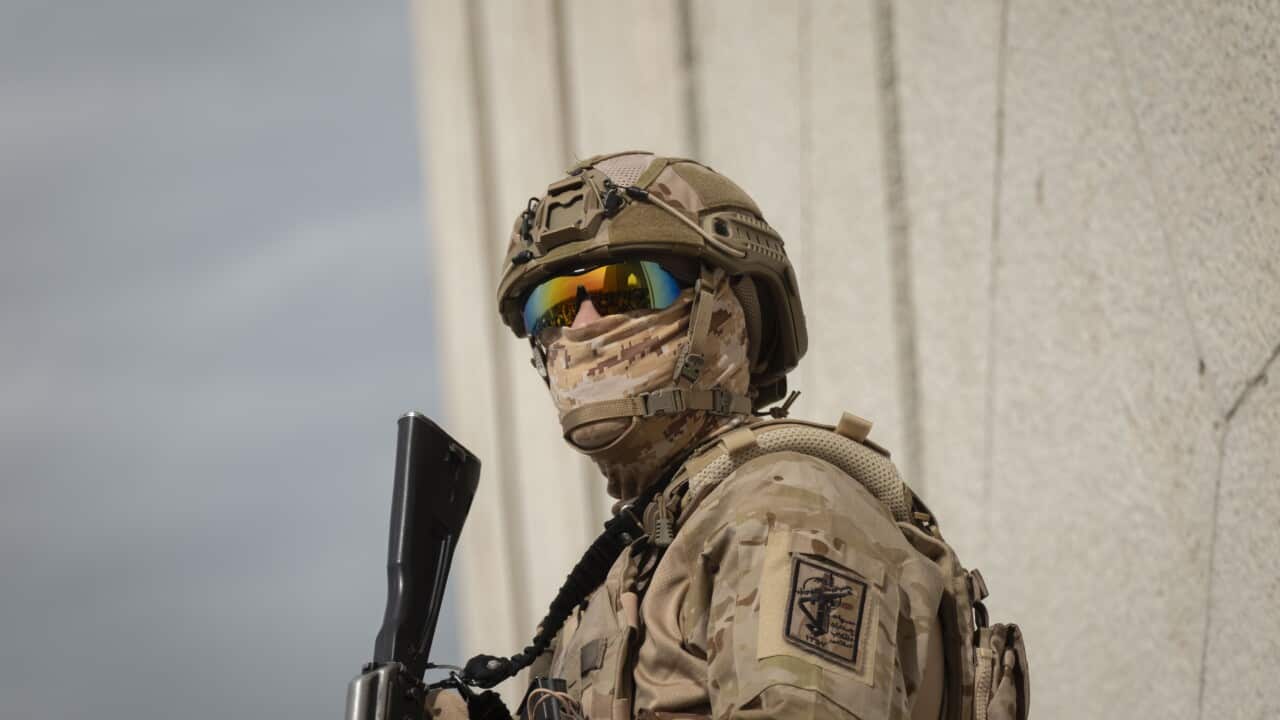
The Australian government is formally reviewing its decision to list the Islamic Revolutionary Guard Corps as a terrorist organisation under the Criminal Code.
The original decision was made in November 2025 following an ASIO assessment that the IRGC had orchestrated attacks against Australia's Jewish Community.
Earlier in the year, in August, Iran's ambassador had been given just seven days to leave after the same allegations.
Iran's foreign ministry has condemned the terrorism designation, calling it illegal and unjustifiable.
Former detainee Dr Kylie Moore-Gilbert says she fully backs the diplomatic crackdown and the push for a formal terrorist designation.
She believes these steps are a long-overdue response to the regime's foreign interference on Australian soil.
"During the two years, plus two years and three months, I spent in the Iranian prison system. I was largely in the custody of the I-R-G-C for most of that time the I-R-G-C intelligence organisation. So I support the government and commend the government on their prescription of this clearly terrorist actor and designation of Iran as a state sponsor of terrorism... and also commend the government for expelling the Iranian Ambassador last year as well."
Speaking to the inquiry, Ms Gilbert says that while the laws are now in place, the follow-through needs to be stronger.
She says the government has done a good job by officially recognising the I-R-G-C as a threat and creating the legal framework to punish them.
But Ms Gilbert says that even though the laws exist, the actual policing of these rules are weak.
“The government’s done really great work as I've highlighted on recognising the threat of the I-R-G-C, of proscribing it and of imposing various sanctions, but the enforcement is sometimes lacking and I think hopefully this committee will be able to draw attention to the need for more resourcing perhaps. In enforcing the prescription, now that it's become law in Australia, sanctioning is merely a symbolic act if we're not actually taking measures to enforce those sanctions after the fact.”
Dr Parissa Glass is a medical researcher at the University of New South Wales, and member of a network of Iranian scholars called the International Community of Iranian Academics.
She says, following the 2022 "Woman, Life, Freedom" protests, the Iranian regime implemented aggressive ideological oversight and demographic engineering to tighten control over higher education.
These restrictive measures have systematically eroded university autonomy while deeply undermining academic freedom across the country.
Students have faced severe consequences for peaceful dissent, including surveillance, criminal charges, suspensions, and expulsions.
Dr Glass says this has resulted in an atmosphere of intimidation and job insecurity, triggering a significant new wave of forced migration among Iran’s most talented scholars and students.
"Between 22 and 26 Iranian universities experience, experience and unprecedented escalation in state repression following the woman life freedom protests in 2022 the Iranian regime intensified its control over higher education through ideological oversight, administrative sanction, campus closures, criminal charges and deliberate demographic engineering. These measures have systematically eroded university autonomy and deeply undermined the academic freedom in Iran during this period, students were suspended expelled surveilled and criminalised for pro peaceful protests."
Iranian-German eye surgeon Dr Amir-Mobarez Parasta is the director of the Munich Eye Centre.
He is leading a medical network called Munich Circle, providing urgent care to Iranian protesters who were shot and subsequently denied medical treatment by the state.
He also runs a structured clinical reporting network that documents systematic and state-sponsored violence across Iran.
He says, based on validated hospital data, they recorded a nationwide death toll of at least 33,130 as of January 2026.
Dr Parasta says this figure remains a conservative estimate designed to withstand the strictest scrutiny while reflecting the catastrophic scale of the massacres.
"I'd like to start with the fatalities based on validated hospital registered death across major cities, and applying it deliberately conservative geographic compilation rule. The modest 15% under attainment adjustment arrive and then at an estimated 33,130 nationwide deaths, that 23rd of January, 2026 which is primarily between 8th and 11th of January."
Iranian authorities have publicly acknowledged at least 3,000 deaths but say the violence was caused by "terrorist acts" fuelled by Iran's enemies.
In mid-January, UN Special Rapporteur Mai Sato told the A-B-C that based on information she received from medical sources, the death toll might be as high as 20,000.
The findings from the I-R-G-C inquiry have yet to be summarised and released, as the committee is still processing the evidence and public testimony gathered during the review.